
The Essential Tools for a High-Performance Kitchen.
“I’m often asked what tools I use to make meal prep faster and healthy eating easier. Here is my curated list of essentials I personally use to stay on track.”
As an affiliate, I earn a small commission from qualifying purchases made through links on this page at no extra cost to you.
The “90-Minute” Prep Station
🥃Glass Meal Container Set
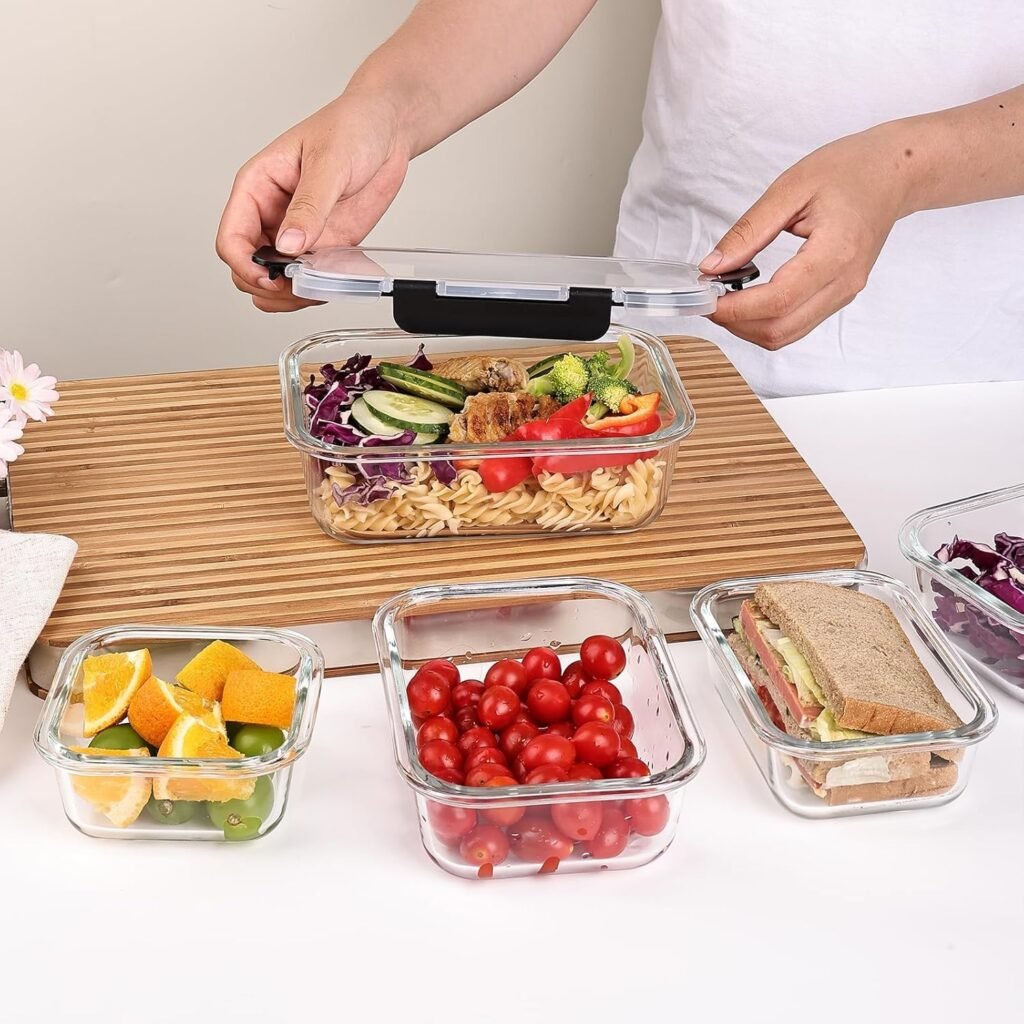
Durable, BPA-free glass containers with airtight lids — ideal for weekly meal prep.
If you’re serious about clean eating, what you store your food in is just as important as the food itself. I always recommend glass over plastic because it’s non-porous and chemical-free; you don’t have to worry about BPA or phthalates leaching into your meals when reheating.
These locking lids are a game-changer for my ’90-Minute System’ because they keep air out, extending the freshness of your prepped veggies by up to three extra days.
If your current “container system” is a chaotic pile of stained plastic lids that never match anything, this set is built to end that mess. The headline benefit is practical versatility: multiple sizes (from 10.5 oz up to 51.1 oz) plus locking, airtight lids that are designed to reduce leaks and keep food fresh longer.
It’s especially strong for meal prep, leftovers, portion control, and grab-and-go lunches—the kind of boring daily stuff that quietly saves you time and money.
Everybody thinks food containers are “just containers”… until you live through the spill. You know the one: you toss your lunch bag on the passenger seat, hit one sharp turn, and suddenly your bag smells like garlic curry for the next 6–8 business days.
Or the fridge version: you swear you’re organized, then you open the fridge and it’s half-eaten leftovers in mismatched tubs, no lids, and that one mystery container you’re afraid to open.
That’s what I’m judging a container set on: does it stop leaks, make leftovers easy, and turn meal prep into something you actually maintain instead of abandoning by Wednesday?
If you want a container set that behaves like an organization tool—not just something you shove into a cabinet—this one checks the boxes that matter: multiple real-life sizes, airtight leak-resistant locking lids, and the convenience of being positioned as oven/microwave/freezer/dishwasher safe.
Bottom line: It’s a solid “infrastructure upgrade” for meal prep and leftovers—especially if you’re tired of plastic chaos and want a more repeatable routine.
Pro Tip: Don’t seal the lid while the glass is still hot from the oven or microwave—let it cool first. This helps prevent pressure buildup, protects the seal, and keeps the lid fitting snug for longer.
Functional Cooking Gadgets
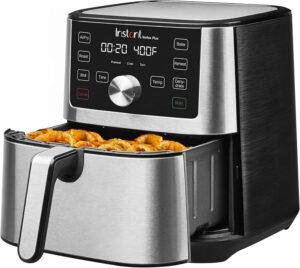
🫕The Air Fryer: My Secret to Oil-Free Flavor
The air fryer is the MVP of my ‘Healthy Hacks’ category. It allows you to achieve that satisfying ‘crunch’ using 80% less oil than traditional frying methods. I use it primarily for roasting chickpeas, making ‘guilt-free‘ sweet potato fries, or quickly cooking proteins when I’m short on time. It uses rapid air circulation to mimic deep-frying, allowing you to enjoy your favorite comfort foods while keeping your inflammatory fat intake to a minimum
If your goal is crispy food without babysitting a deep fryer—and you want something that can also roast, reheat, and even dehydrate—this 6QT Vortex Plus is a high-ROI countertop upgrade. It’s built for speed, repeatability, and “set it and move on” cooking.
What it’s best at: frozen-to-crispy meals, weeknight chicken, roasted vegetables, reheating leftovers without turning them soggy, and meal-prep shortcuts.
Here’s the honest scenario most people live in: you’re hungry, you’ve got limited time, and you don’t want a sink full of regret after dinner.
That’s where this air fryer earns its keep. It’s not “just another gadget.” It’s a process tool for people who want consistent results with minimal mental effort.
Think of it like this: instead of cooking being a whole event, it becomes a quick system—cook fast, crisp well, clean easy.
There’s a specific kind of tired where chopping onions feels like a personal attack. That’s when an air fryer becomes your best friend. You throw in frozen fries, chicken strips, or veggies, hit Air Fry, and you get that “just cooked” crisp without firing up a full oven or drowning food in oil.
The win isn’t just taste—it’s momentum. When dinner becomes easy, you’re more likely to eat at home instead of defaulting to expensive takeout.
If you want a fast home-cooked dinner without overthinking it, air fryers are basically a shortcut. Chicken thighs, drumsticks, wings—these are exactly the kinds of meals where you want heat + airflow doing the heavy lifting so you get crispy skin and cooked-through meat without standing there watching the oven like it’s a suspense movie.
Pro Tips: Different brands run hotter or cooler. I treat the first few recipes as experiments: start with the lower end of the time range, check early, and note what works for my specific model.
Healthy Cooking Tools
🍳Cast Iron Skillet or Non-Toxic Ceramic Pan
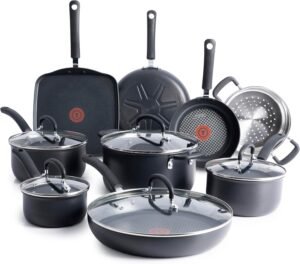
Standard non-stick pans often contain ‘forever chemicals’ (PFAS) that can off-gas at high temperatures. I’ve switched my kitchen to non-toxic ceramic and cast iron to ensure a clean cooking surface. Beyond the health benefits, cast iron adds a superior sear to proteins like grass-fed steak or wild-caught salmon, and it even provides a tiny, natural boost of dietary iron to your meals. It’s a tool that lasts a lifetime.
If you want a nonstick set that can take daily use without turning into a scratched-up headache, this T-fal hard anodized set is a strong “kitchen operating system” upgrade. It’s designed to handle real-life cooking—eggs, sautéed veggies, quick pastas, searing chicken—without requiring chef-level patience or cleanup rituals.
The headline value: hard anodized durability + easy-release nonstick + a complete set that covers most cooking situations (fry pans, saucepans, griddle, dutch oven, etc.)
I’ve learned this the annoying way: cookware doesn’t fail in one dramatic moment. It fails slowly—food starts sticking, you scrub harder, the surface gets worse, and suddenly cooking feels like a chore you avoid.
That’s why I like sets like this when you’re either:
- starting fresh (new kitchen, new home, tired of mismatched pans), or
- replacing the “graveyard collection” of warped pans and mystery lids.
For me, the real test isn’t “does it look nice.” It’s: does it make weeknight cooking faster, cleaner, and less annoying?
Eggs are the nonstick truth serum. When a pan is bad, you know immediately—sticking, tearing, scraping, and suddenly breakfast feels like punishment.
With a good nonstick pan, eggs are “two minutes and done,” which matters more than people admit. If your cookware makes you dread simple meals, you cook less. If it makes cooking easy, you cook more. That’s the compounding benefit.
Pro Tips:
Practical use case: start something on the stove (like chicken thighs) and finish in the oven for even cooking—without switching pans.
Don’t be reckless: if you’re using lids in the oven, keep them within the stated limit. And avoid cranking empty nonstick pans on high heat—nonstick performs best with controlled temps.
The Clean Pantry Staples
🫒Bertolli Extra Virgin Olive Oil
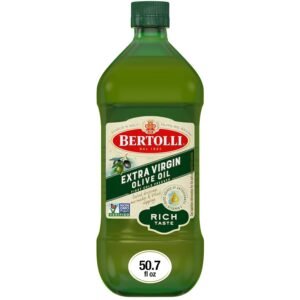
Health starts with the basics. Many store-bought oils are rancid before they hit the shelf. I look for cold-pressed oils in dark bottles to protect the antioxidants.
This is the kind of olive oil that’s built for daily use: cooking, quick dressings, roasting, finishing, and the “I need dinner to taste better instantly” moments. The big bottle size (50.7 fl oz) is the real value play because you stop rationing olive oil like it’s liquid gold.
If you want an EVOO with a richer flavor profile that can pull boring meals out of the gutter, this one is a solid pantry staple.
I didn’t always care about olive oil. I used to buy whatever was cheapest, then wonder why my “healthy” meals tasted flat. The turning point was a simple salad—tomatoes, salt, and olive oil. Nothing fancy. When the oil is weak, that salad tastes like nothing. When the oil is good, it tastes like you did something intentional.
That’s the role olive oil plays in my kitchen now: it’s not a “special ingredient.” It’s a flavor multiplier. It’s how you make simple food taste like you know what you’re doing.
What This Olive Oil Is Best For
Bertolli labels this one as a “Rich Taste” extra virgin olive oil—so the expectation is a more pronounced flavor that holds up in everyday cooking and finishing.
Here’s where I personally get the most value from a rich EVOO:
- Roasted vegetables: olive oil + salt + heat = instant “restaurant vibe.”
- Quick pasta finish: a drizzle at the end makes basic pasta taste upgraded.
- Salad dressing in 10 seconds: olive oil + lemon/vinegar + salt.
- Protein boost: chicken, fish, eggs—olive oil adds flavor and prevents dryness.
- Bread dip moments: when you want a snack that feels fancy.
You know the salad that feels like punishment? Lettuce, cucumbers, maybe a tomato… and you’re chewing while regretting your life choices. A richer olive oil is one of the fastest ways to fix that. I’ll do a simple dressing: olive oil, lemon, salt, and cracked pepper. That’s it.
When the oil has actual character, you don’t need a dozen ingredients. It carries the whole thing.
Bertolli Extra Virgin Olive Oil (Rich Taste) is a strong pick if you want a reliable, everyday EVOO that makes basic food taste better with minimal effort—especially in a big bottle size that encourages you to actually use it.
If your goal is to eat more at home, spend less on takeout, and still enjoy your food, this is one of those “small upgrades” that pays back daily.
Pro Tip: Keep the bottle neck clean and Control the pour to avoid waste.