GLP-1 Meal Prep Plan: One Pan, 3 Days, 25 Minutes
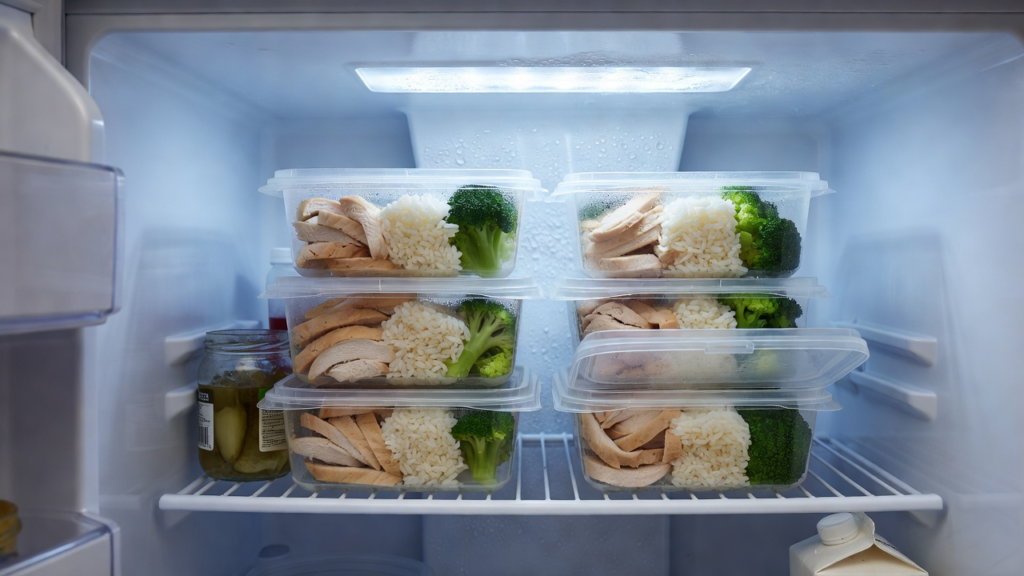
GLP-1 meal prep breaks the moment your appetite does. Let me guess. You’ve got eight containers of chicken and rice in the fridge. You cooked them Sunday. It’s Tuesday. You’ve eaten maybe one and a half. The rest are just sitting there, judging you. And now you feel like a failure at eating, which is a special kind of ridiculous. Here’s what nobody told you when you started semaglutide or tirzepatide: your old system isn’t just inconvenient now. It’s actively working against you. So what does meal prep for a small appetite actually look like?
GLP-1 meal prep means cooking one pan every three days, not six servings every Sunday. Build each portion around a fatty protein, a sturdy vegetable, and a sauce, then divide it into 8-ounce containers at 350-400 calories and 30+ grams of protein each. Small volume, high density, zero assembly.
Everything below is the reasoning behind that paragraph.
Table of Contents
Why GLP-1 Meal Prep Advice Feels Like Diet Culture Again
You know who you are. You’ve been on semaglutide or tirzepatide for a few months. You’ve read the Reddit threads. You’ve seen forty influencers post the same sheet pan of broccoli and salmon with a caption about “fueling your journey.”
You’re tired. You’re a little nauseated. And you’re deeply suspicious of anyone selling you a system.
Fair enough. You’ve been burned before — by diet culture, by macros apps, by the person who told you willpower was the problem when it turned out your body just didn’t make enough GLP-1.
So I’m not going to tell you this is magic. I’m going to tell you it’s math. And I’ll say upfront that I’m not a physician. This is a kitchen system, not medical advice. Your prescriber and a registered dietitian should sign off on your protein and calorie targets, especially if you have kidney disease or a history of disordered eating.
Your Appetite Shrank on Semaglutide but Your Portions Didn’t
This is the whole problem in one sentence.
GLP-1 medications slow gastric emptying. A 2024 systematic review and meta-analysis of 15 studies put the pooled gastric half-emptying time at about 138 minutes on a GLP-1 versus about 95 minutes on placebo. Food sits in your stomach roughly 45 minutes longer. You feel full after four bites of a meal you used to finish in ten minutes.
That’s not a side effect. That’s the mechanism working.
But here’s what happened to your kitchen. You’re still cooking like a person with a normal appetite:
- You make full-size portions because recipes come in full sizes
- You batch cook six servings because that’s what meal prep means
- You end up with food waste, decision fatigue, and a fridge full of guilt
Meanwhile your actual intake might be 900 calories on a rough day. Most of it whatever was easiest to grab.
I threw out four containers of chicken and rice in a single week during month two. Not because the food was bad. Because I kept cooking for a person who no longer lived in my body.
Muscle Loss and Undernutrition Are the Real GLP-1 Risk
This is the part critics skip. When people hear “GLP-1 meal prep,” they picture someone trying to restrict harder. Another diet hack. Another rule.
Wrong direction entirely. The genuine danger on these medications is undernutrition.
Protein Shortfall and Lean Mass Loss on GLP-1s
The numbers here are not vague. In the STEP 1 body-composition substudy, people on semaglutide lost about 6.9 kg of lean mass out of 15.3 kg total — roughly 45% of everything they lost. In the SURMOUNT-1 substudy of tirzepatide, lean mass made up about 26%. A 2024 review by Neeland and colleagues in Diabetes, Obesity and Metabolism put the range across the drug class at 25-40% of total weight lost.
That’s not a reason to stop the medication. It’s a reason to eat protein. Most obesity medicine clinicians target 1.2 to 1.6 grams of protein per kilogram of body weight per day during active weight loss. For a 180-pound person, that’s roughly 100 to 130 grams. From a stomach that quits after four bites.
The good news is that this is fixable. A published case series on lean-tissue preservation followed patients who paired semaglutide or tirzepatide with resistance training three to five days a week and deliberate protein intake. Their body composition outcomes looked nothing like the trial averages.
Micronutrient Gaps from Eating Less Food
Less food volume means less of everything. Iron, B12, calcium. You don’t get a warning signal for this the way you do for hunger.
Dehydration While Your Appetite Is Suppressed
You’re not thirsty either. Appetite suppression is broad, and thirst goes quiet along with hunger.
So your meal prep job changed. It used to be “control portions.” Now it’s “make every bite count when there aren’t many bites.”
That’s a totally different engineering problem. And sheet-pan chicken and rice does not solve it.
Why One-Pan Meals Work Best for a Small Appetite
Here’s where the skeptic starts listening. One-pan cooking isn’t about being trendy or Instagram-friendly. It’s about three things that matter enormously when you’re eating less.
Nutrient Density Per Square Inch
Cook everything in one pan and the fat and juices from the protein coat the vegetables. Flavor and calories land in the same bite. You don’t add volume to get them.
Now picture the alternative. A dry chicken breast in one container. Plain steamed broccoli in another. You’ll eat four bites and quit.
If vegetables are a hard sell for you in the first place, the same density logic applies with almost no greenery involved — I broke that down in this framework for high-protein clean eating without vegetables.
Texture Control to Prevent GLP-1 Nausea
Nausea is the number one reason people stop these medications — reviews of GLP-1 tolerability consistently list gastrointestinal side effects as the leading cause of discontinuation. Dry, chalky, reheated protein is a nausea trigger. Braised, saucy, one-pan food reheats better because it’s already sitting in moisture.
Zero Assembly During Your Appetite Window
This sounds minor. It isn’t. When your appetite window opens — and it opens and closes fast on GLP-1s — you have about ninety seconds of willingness. Anything requiring assembly loses.
GLP-1 Portion Sizes: The Meal Prep Math That Actually Works
Stop making six servings. Make one pan that yields three to four small-appetite portions, and make it every three days instead of every seven.
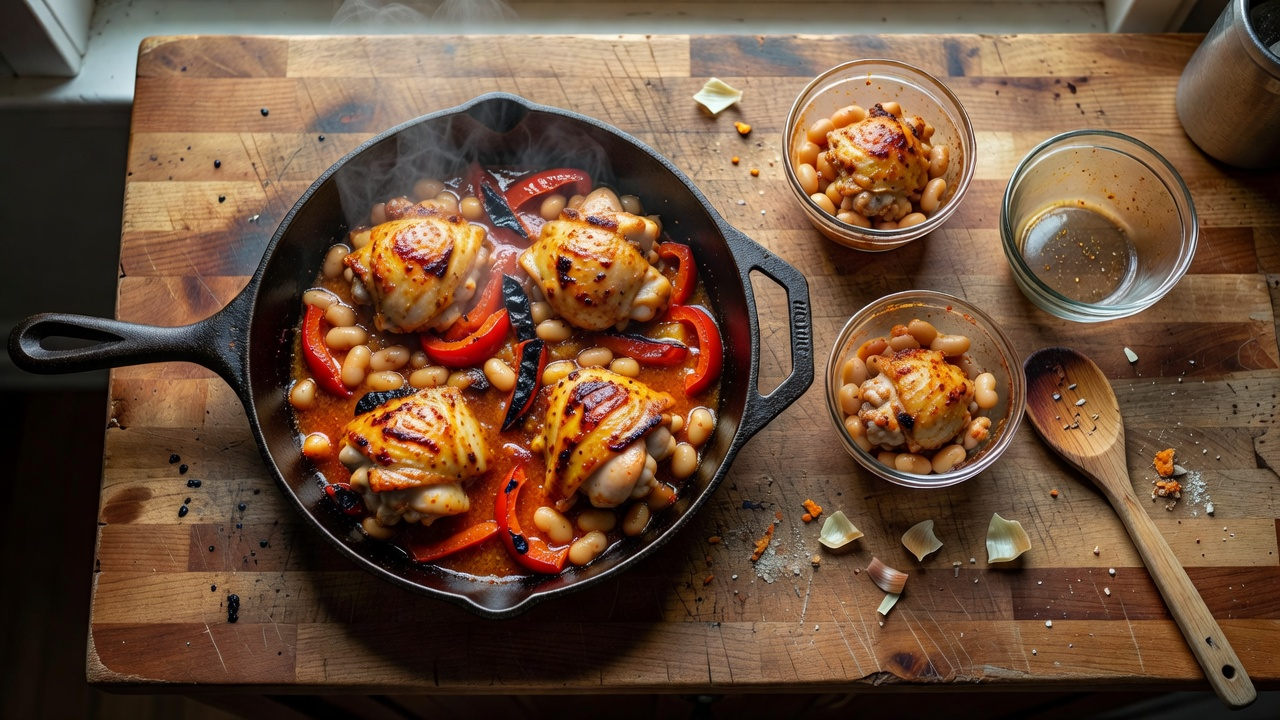
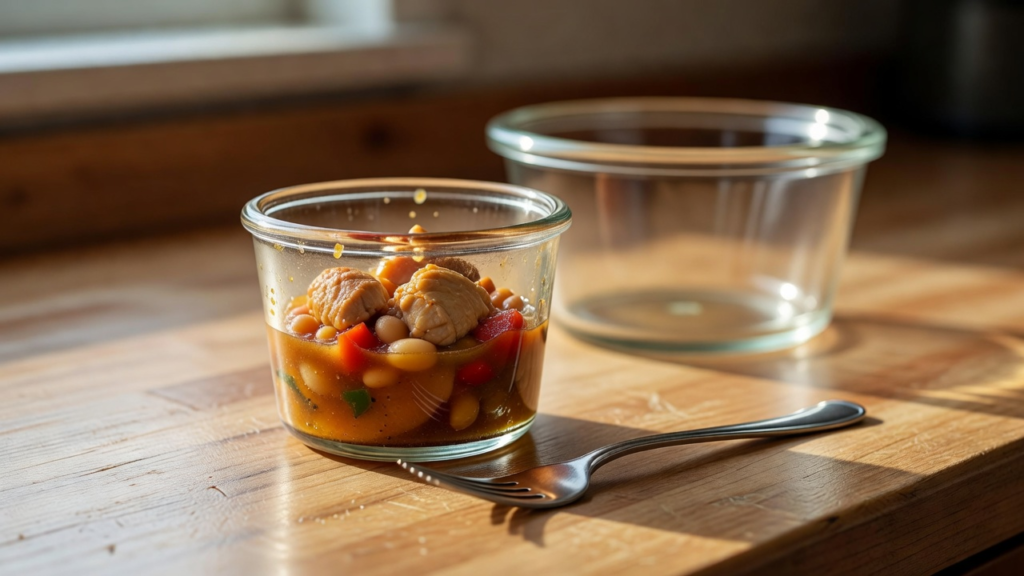
Concrete example. A 12-inch skillet with:
- 1 lb chicken thighs (not breast — thighs stay moist, higher fat, more calories in less volume)
- 1 can white beans
- Half a jar of roasted red peppers
- Olive oil, garlic, paprika
That’s roughly 4 portions at around 350-400 calories and 30+ grams of protein each.
Each portion is physically small. Maybe a cup and a half. You’ll actually finish it. That’s the entire test.
Are Protein Shakes Enough on GLP-1 Medications?
Yes, you could just drink one. And a lot of days, you should.
But here’s what happens when shakes become your default. Your relationship with actual food erodes. You stop cooking. You stop sitting down. You start treating eating as a chore to be minimized rather than a thing you do.
Then the medication ends — or you plateau, or insurance drops you — and you have no functioning food system left. Just a habit of not eating.
The people who keep their results are the people who kept eating real meals in the shrunk-down size. That’s not a moral point. It’s a practical one.
4 GLP-1 Meal Prep Rules for High-Protein, Small Portions
If you take nothing else, take these.
Rule 1: Fat Is Your Friend Now
Not because fat is healthy or unhealthy. Because you need calorie density in small volume. Olive oil, thighs over breast, full-fat dairy, avocado. Lean-everything was advice for people who ate too much.
Rule 2: Cook Wet, Not Dry
Braises, skillet sauces, anything with liquid. Roasted-until-crispy reheats into sandpaper. Sandpaper triggers nausea. Nausea ends adherence.
Rule 3: One Pan, Three Days, Small Containers
Use 8-ounce containers, not 32-ounce ones. A half-empty big container looks like failure. A full small container looks like a meal.
Rule 4: Front-Load Protein in the First Two Bites
You might only get four. Make the first ones count.
Watch: A Dietitian on Hitting Protein With a Suppressed Appetite
If you want to hear this from someone with credentials rather than a skillet, registered dietitian Ana Reisdorf — a GLP-1 user herself — walks through the protein strategy in about ten minutes. It lines up almost exactly with Rule 1 and Rule 4.
Is One-Pan Meal Prep Too Much Work on Low Energy?
“This is just more work, and I have less energy than ever.”
That’s real. Early months on these drugs can be genuinely exhausting.
But compare honestly. Traditional meal prep is a three-hour Sunday. One-pan, three-day cooking is about twenty-five minutes, twice a week. Less total time. Less cleanup. Less waste.
And the waste matters more than people admit. Throwing out food you cooked but couldn’t eat is demoralizing in a way that compounds. It tells you a story about yourself that isn’t true.
How GLP-1 Meal Prep Protects Your Relationship With Food
Let me be direct about the emotional part.
People on GLP-1s lose weight, and that’s the headline. But a lot of them quietly lose something else — the feeling that food is a normal, pleasurable, unremarkable part of being a person. Eating becomes clinical. A protein target. A chore.
One-pan cooking pushes back on that. It’s a real meal. It smells like something. It’s warm. It just happens to be sized for the body you have right now rather than the appetite you used to have.
That matters for adherence, because misery ends prescriptions. But it also just matters.
Muscle Preservation Is What Makes GLP-1 Results Hold
The strongest case for this approach isn’t about weight at all.
Two things decide whether your results last: how much muscle you keep, and whether you’re actually well-fed. Not the number on the scale in month three.
Food is the lever you control. Your medication handles appetite. Resistance training handles the stimulus. Food is the third leg, and it’s the one most people drop.
You cannot get 100+ grams of protein a day from food you don’t eat. Everything else is downstream of that single fact.
The Kit That Makes One-Pan GLP-1 Meal Prep Work
As an Amazon Associate, I earn from qualifying purchases. Every item below is something the system actually requires — there is no gear here for the sake of gear.
A 12-inch cast iron or stainless skillet — This is the whole method in one object. Twelve inches is the size that holds a pound of thighs plus a vegetable and still leaves room for sauce. Cast iron goes stovetop to oven, which is how you get a sear and a braise in the same pan.
8-ounce glass meal prep containers — Rule 3 doesn’t work without these. Buy a set of at least six so you’re never choosing between a big container and no container. Glass also reheats without the plastic-smell problem, which matters more than usual when your nausea threshold is low.
An enameled cast iron braiser — Optional, but it’s the single best pan for Rule 2. Wide, shallow, heavy lid, holds liquid. If you’re going to cook wet, this makes it effortless.
A good extra virgin olive oil — You’re using fat as a calorie-delivery system now, so quality actually shows up in the finished dish. A tablespoon is roughly 120 calories in a volume your stomach won’t even notice.
Unflavored whey protein isolate — Not for shakes. Stir a scoop into the sauce in the pan off the heat, or into soup. It’s the cheapest way to move a 22-gram portion to 40 grams without adding a single bite of volume.
Sugar-free electrolyte packets — For the dehydration problem. If thirst has gone quiet, flavored water you’ll actually finish beats plain water you keep forgetting about.
A digital kitchen scale — Not for restriction. For the opposite. When you’re eating 900 calories and don’t know it, a scale is how you find out what a 30-gram protein portion physically looks like in a small container.
GLP-1 Meal Prep FAQ
How much protein should I eat per day on a GLP-1?
Most clinicians working in obesity medicine use 1.2 to 1.6 grams per kilogram of body weight during active weight loss. For a 180-pound person, that’s about 100 to 130 grams a day. Split across three small meals, that’s 30 to 45 grams per container. Confirm your own number with your prescriber, particularly if you have kidney disease.
How long does one-pan GLP-1 meal prep take?
About 25 minutes, twice a week. That’s roughly 50 minutes total, compared with the traditional three-hour Sunday prep session. You’re cooking less food, so there’s less chopping, less cleanup, and nothing to throw away on Friday.
How many days will one pan of food last?
Three days in the fridge, which is also the food-safety ceiling for most cooked proteins. That’s the reason for the three-day cycle rather than a seven-day one. You’re not just avoiding boredom, you’re staying inside the window where reheated food still tastes good enough to finish.
What foods make GLP-1 nausea worse?
Dry, dense, and very greasy food are the usual triggers, along with anything strongly aromatic. Reheated roasted chicken breast is a common offender because it dries out further in the microwave. Saucy, braised, moderately fatty food in small portions is generally better tolerated. Eating slowly and staying upright afterward helps too.
Can I still meal prep if I’m on the maintenance dose and my appetite came back?
Yes, and the system scales. Keep the one-pan structure and move to 12-ounce or 16-ounce containers, or simply eat two small containers instead of one. The reason to keep the habit is that appetite on these medications is not stable — it shifts with dose changes, illness, and dose timing within the week.
Should I use chicken breast or chicken thighs on a GLP-1?
Thighs, most of the time. They hold moisture through reheating, which directly addresses the texture problem, and they carry more calories in the same physical volume. Breast is fine when it’s braised in liquid or sauced. It’s the dry, reheated version that ends up back in the trash.
Do I need supplements on a GLP-1?
Possibly. Eating 900 to 1,200 calories a day makes it hard to hit iron, B12, calcium, and vitamin D from food alone. Ask your prescriber for bloodwork rather than guessing, and treat supplements as backup for a food system, not a replacement for one.
How to Start Your First One-Pan GLP-1 Meal Prep Tonight
Your appetite changed six months ago. Your kitchen is still cooking for the person you were. That gap is the whole problem, and no shake, supplement, or tracking app closes it. A smaller pan does.
GLP-1 meal prep isn’t a diet. It’s a resizing job. Fatty protein, one sturdy vegetable, a fat, a flavor, one skillet, three small containers, three days.
So do this tonight, before you overhaul anything: take the protein already in your fridge, cook it in one pan with oil and garlic, and divide it into 8-ounce containers before you sit down. Eat one. See if you finish it. That single test will teach you more about your body than any guide will, including this one.
More small-portion, high-protein cooking is over at Healthy Recipes.