
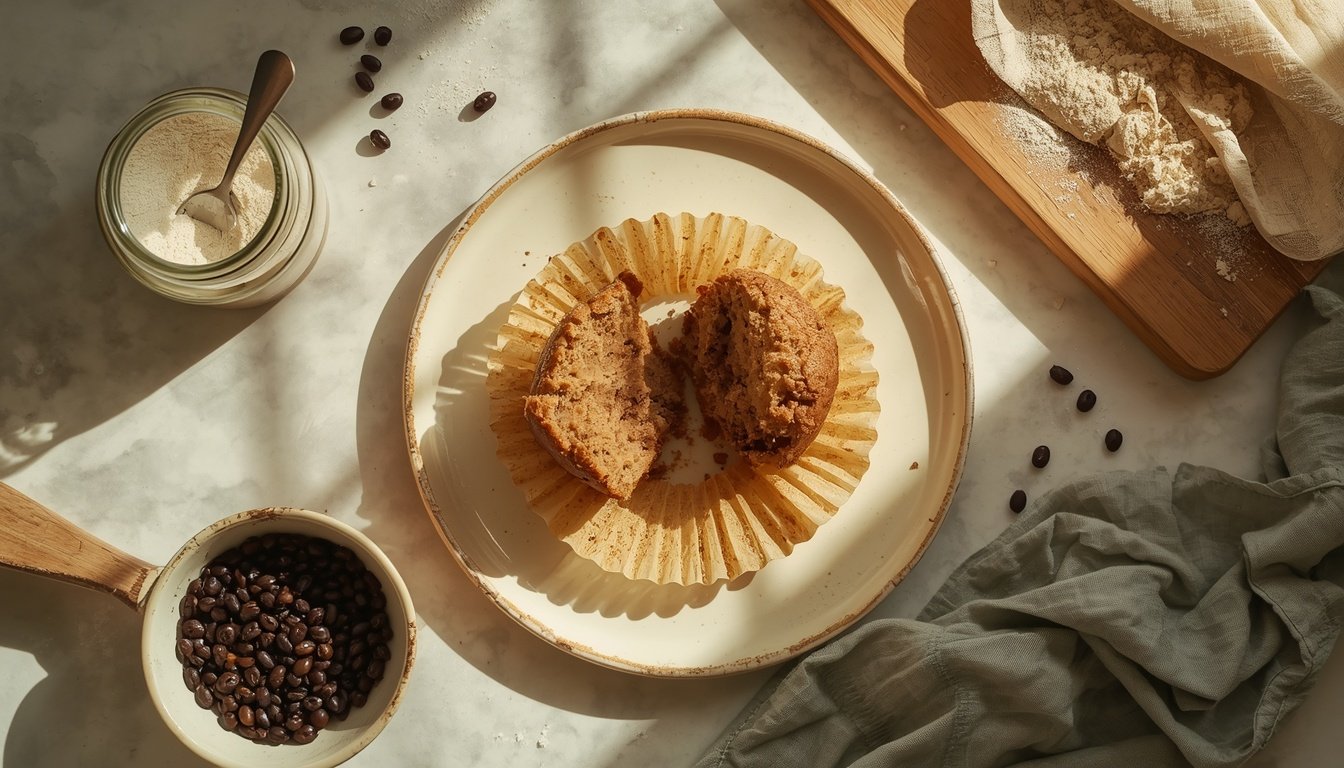
How to Add Fiber to Any Recipe (Without Tasting It)
You can add fiber to any recipe without a single person at your table noticing. That’s a big claim, and you’ve heard some version of it before — probably right before you bit into a black bean brownie and tasted the beans.
The numbers say we need the help. US adults average about 16.6 grams of fiber a day against a target of 25 grams for women and 38 for men, and a 2021 analysis of NHANES data by Derek Miketinas, PhD, RD, of Texas Woman’s University found that only 5% of men and 9% of women hit the recommendation.
You already know that part. Everybody knows that part. The problem isn’t knowledge. It’s trust. So let’s skip the lecture and look at evidence instead.
How Do You Add Fiber to a Recipe Without Changing the Taste?
To add fiber to any recipe without changing the taste:
- Grind or purée the fiber source as fine as possible.
- Add one extra tablespoon of liquid per tablespoon of fiber.
- Let batters rest 10 minutes before cooking.
- Start at 25% of the original ingredient and build up.
- Use strong flavors like chocolate or spice as cover.
That’s the answer. The rest of this piece is why you should believe it.
Who This Is For: Home Cooks Burned by High-Fiber Swaps
I’m not writing this for someone who already buys oat bran in bulk. I’m writing for the good home cook. The one who makes real food. The one who hears “high fiber” and thinks dry, gritty, and vaguely sad.
This person has been burned. They made the black bean brownies. They tasted the beans.
If you’re the kind of cook who’d rather sidestep the vegetable aisle entirely, I’ve written about that too: clean meal prep for people who hate vegetables.
Here’s what they trust:
- Blind taste tests, where nobody knows what they’re eating
- Professional chefs who’d get fired for serving bad food
- Food companies who’d lose money if customers noticed
- Traditions that lasted centuries with no health agenda
- A clear mechanism — why it works, not just that it did
And here’s what they dismiss instantly:
- “You won’t even notice!”
- Before-and-after photos
- Anything a wellness brand is selling
- Anyone whose income depends on you believing them
Fair enough. So I’ll only use the first list.
Two things before we start. I don’t work for a fiber company and nobody paid for a mention in this piece. Some of the links below are Amazon affiliate links, which means I earn a small commission if you buy through one — it costs you nothing extra, and every item listed is something already sitting in my own kitchen. You can also buy all of it at a normal supermarket without clicking anything. I’ve cooked with every technique here, including the batches that failed, which is how I learned what actually matters.
Ten lines of evidence. Different countries, different centuries, different methods. None of them talked to each other.
10 Proofs You Can Add Fiber to Any Recipe
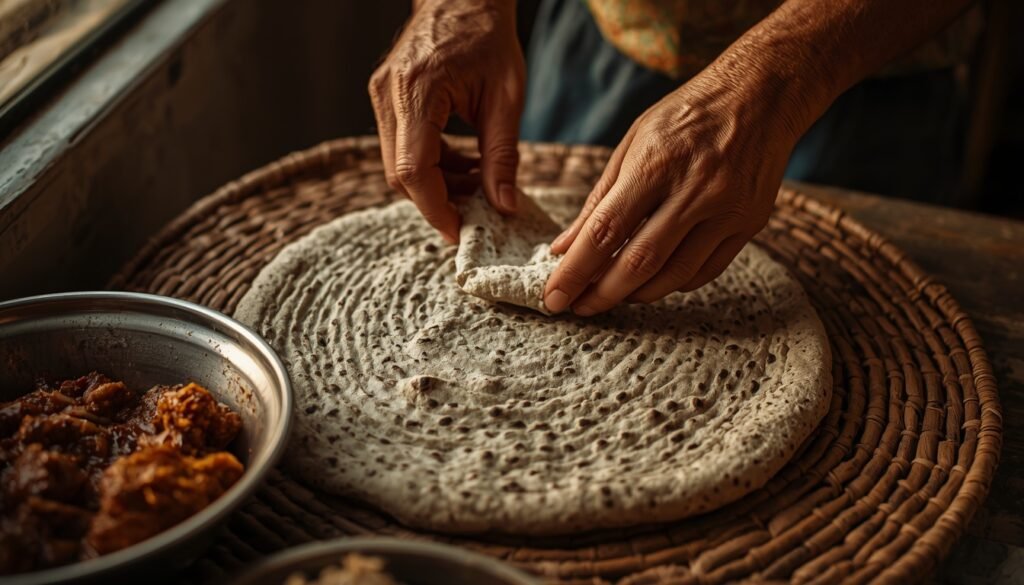
1. Teff and injera: Ethiopia’s fine-grind fiber trick
Injera is the flatbread at the center of Ethiopian meals. It’s made from teff, a tiny grain packed with fiber. Nobody in Ethiopia chose teff for its fiber. They chose it because it grows well and tastes good.
The technique: grind your fiber source extremely fine, then ferment it. Teff flour is milled to near-dust. Fermentation softens it further and adds sour depth.
Fine particles don’t register as grit on your tongue. That’s the whole secret, and it shows up again and again below.
2. Refried beans: how Mexican cooks purée fiber into sauces
Refried beans aren’t a side dish in much of Mexico. They’re a base. Spread on tortillas, stirred into sauces, thickening everything.
Beans pack more fiber than almost anything else you can eat. The corn in the tortilla adds more.
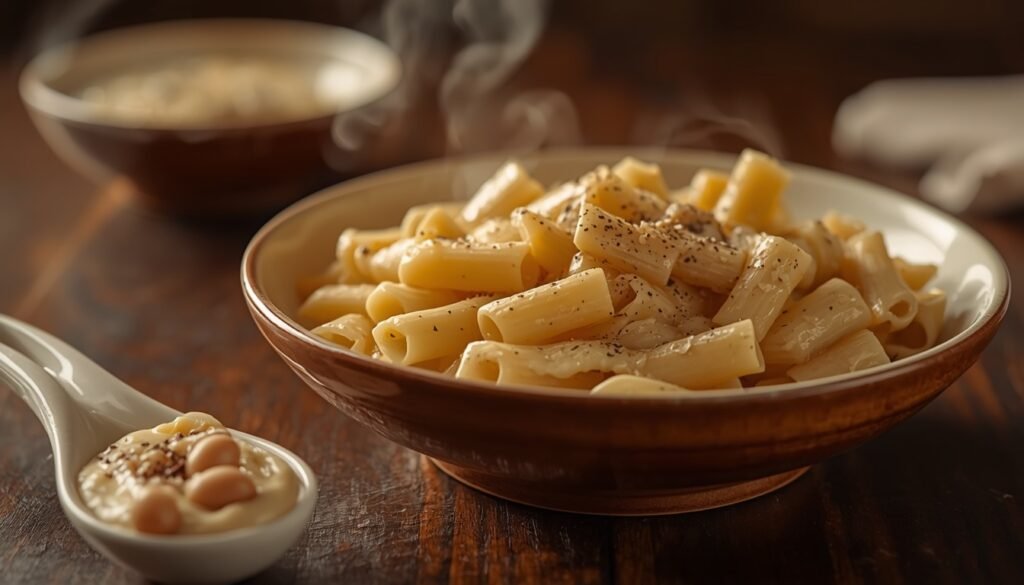
The technique: purée beans until completely smooth, then use them where you’d use fat or thickener. Black bean purée in chili. White bean purée in creamy pasta sauce.
Smooth white bean purée tastes like almost nothing. It’s mild, starchy, and it makes sauces silkier. This tradition is roughly 4,000 years old. Nobody was counting grams.
3. Konjac and agar: Japan’s high-fiber texture tools
Konjac and kanten (agar) are both nearly pure fiber. Both are Japanese kitchen staples going back centuries. Konjac becomes shirataki noodles. Kanten sets desserts like gelatin.
Japanese cooking is famously strict about texture. If these ingredients tasted bad, they’d have been dropped long ago.
The technique: use fiber for structure instead of flavor. Agar sets a panna cotta. Konjac bulks up a noodle bowl. You’re not adding a health ingredient. You’re adding a tool.
4. Inulin powder: why food companies add chicory root fiber
Here’s the most cynical evidence available. And that makes it strong.
Chicory root fiber (inulin) shows up in a huge range of packaged foods. Snack bars, yogurts, ice creams, breads. Food companies run massive taste panels. They lose real money when a product tastes worse than the last version.
They use inulin anyway. Why? It’s slightly sweet, mildly creamy, and dissolves invisibly into liquids.
The technique: stir a teaspoon or two of inulin powder into anything wet. Coffee, smoothies, yogurt, soup, pancake batter. It vanishes. A billion-dollar industry bet on that.
5. Sensory science: does fiber actually have a taste?
Trained sensory panels test ingredients blind. Panelists get numbered samples and describe what they detect.
Pure fibers like inulin, psyllium and resistant starch barely register. They’re not bitter. They’re not sour. They’re close to nothing.
So why do so many fiber swaps fail? In blind tests, people don’t complain about the taste. They complain about the feel. Dry. Gritty. Gummy. That’s a fixable problem, not a dead end.
Which brings us to the mechanism.
6. The chemistry: why high-fiber baking comes out dry
Fiber is thirsty. Soluble fiber especially. It grabs water and holds onto it.
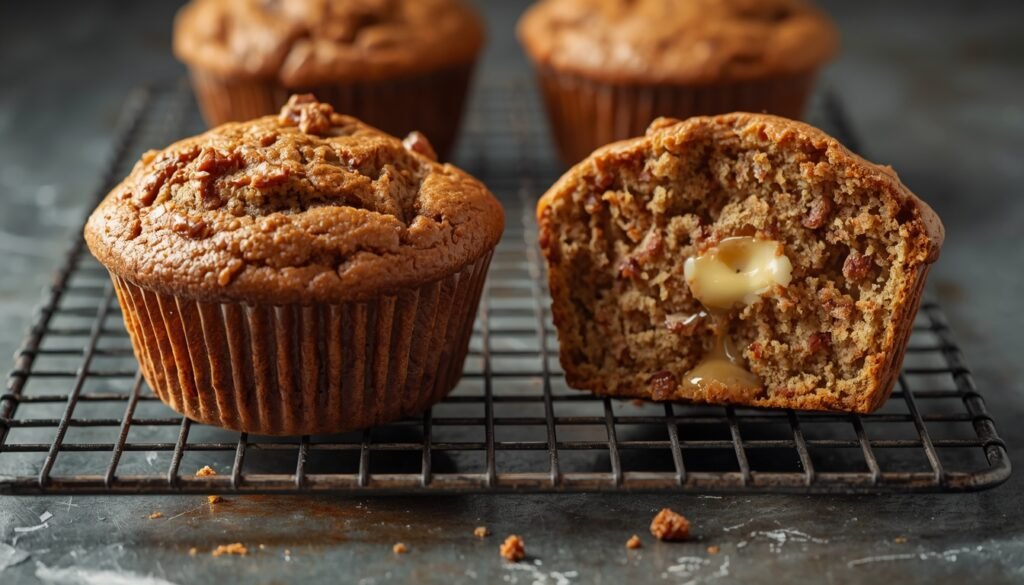
Add fiber to a muffin batter without adding liquid, and the fiber steals water from the crumb. The muffin comes out dry. People taste that dryness and blame “healthy flour.” They’re blaming the wrong thing.
I’ve made the same bran muffin recipe both ways more times than I want to admit. Same flour, same oven, same morning. The batch with an extra tablespoon of milk and a ten-minute rest comes out soft. The batch without it comes out like a sponge left on the counter. Nothing else changed.
The technique — the most important one here:
- Add your fiber.
- Add extra liquid, roughly a tablespoon per tablespoon of fiber.
- Let the batter rest 10 minutes before baking.
That rest lets the fiber drink first. Then it stops stealing. Particle size matters just as much. Fine-ground beats coarse every time.
7. Britain’s National Loaf: what a failed high-fiber bread proves
During World War II, Britain introduced the National Loaf. It was a high-extraction wheat bread made to stretch scarce grain. People hated it. Complaints were constant — grey, heavy, coarse.
This looks like evidence against my argument. It’s actually evidence for it.
The National Loaf didn’t fail because it had fiber. It failed because the bran was coarse, there was far too much of it, and nobody adjusted the water. That is exactly the failure the chemistry predicts.
Go too coarse, too fast, and people notice. Go fine and gradual, and they don’t.
8. Prune purée: the pastry chef trick for moist high-fiber cake
Ask a professional baker about prune purée in chocolate cake. It’s an old trade trick. Prune purée replaces some of the fat. The cake stays moist. Chocolate covers everything.
Same with applesauce in quick breads. Same with pumpkin purée in muffins. These chefs weren’t chasing fiber. They wanted moisture, shelf life, and lower costs.
The technique: replace up to about half the fat in a baked good with fruit or vegetable purée. Start with a quarter if you’re nervous. Dark, strongly flavored recipes hide the most — chocolate, spice cake, gingerbread, banana bread.
These people sell their food for money. That’s the standard your skeptic actually respects.
9. The blended burger: mushrooms that add fiber to ground meat
Culinary researchers at the Culinary Institute of America developed the “blended burger,” mixing finely chopped mushrooms into ground beef, and UC Davis food scientists helped work out why it improves both flavor and nutrition. The James Beard Foundation turned it into a national chef competition, and restaurants put it on real menus for real customers. The Mushroom Council now puts the starting ratio at 25% mushrooms.
The results weren’t “acceptable.” Tasters often rated the blended version as juicier and more savory. Mushrooms bring glutamates, which deepen meaty flavor. They also bring water and fiber.
The technique: finely chop or pulse mushrooms in a food processor, then mix them into ground meat at about 25%. Works in burgers, meatballs, bolognese, tacos. America’s Test Kitchen takes it further and processes the mushrooms to a paste, then microwaves the paste to drive off water before the beef goes in.
The flavor doesn’t get worse. It gets better.
Watch the technique: mushrooms blended into ground beef
Reading about it gets you halfway. Watching someone pulse mushrooms down to a paste and fold beef into them takes four minutes and kills off the last of the doubt.
Watch how fine they take the mushrooms before any beef goes in. That’s the particle-size rule doing its work in real time.
10. Hospital kitchens: psyllium husk powder that dissolves invisibly
Clinical dietitians face a hard problem. Patients need fiber. Patients also refuse food they don’t like. If a fiber addition tastes bad, the patient stops eating. That’s a medical failure, not a preference.
So clinical kitchens rely on tasteless, dissolvable fibers. Psyllium husk powder stirred into liquids. Fiber blends mixed into purées and porridge. They chose these because they disappear. Nothing else works when compliance is life-or-death.
The technique: psyllium husk powder thickens things beautifully. A teaspoon in oatmeal, soup, or a smoothie adds body and no flavor. Drink water alongside it — Mayo Clinic makes the same point about every fiber increase, and it’s the one rule people skip.
What All Ten High-Fiber Methods Have in Common
Almost nothing. Ethiopian bakers never met Japanese chefs. Neither met a food scientist. A 1942 British bakery had no connection to a modern hospital dietitian.
Different centuries. Different continents. Different goals entirely — flavor, profit, survival, medicine, tradition.
They used different methods, too. Recipes handed down for generations. Taste panels run by food companies. Lab tests that measure how much water fiber holds. Skills passed from chef to chef. Patient data from hospitals.
Some had a financial motive. Some had none. Some had a health motive. Most didn’t.
And every single one landed on the same answer: fine particles, enough water, gradual increases, strong flavors as cover.
One source proves nothing. A food company could be wrong. A tradition could be lucky. A study could be flawed. But ten sources with no shared bias, no shared method, and no shared era? That’s not a coincidence. That’s what a real finding looks like.
How to Add Fiber to Any Recipe This Week: A Starter Kit
Pick one. Try it this week.
- Stir a teaspoon of inulin powder into your coffee or smoothie
- Swap 25% of white flour for finely milled whole wheat, and add a splash of extra liquid
- Pulse mushrooms into your next batch of meatballs — the same trick works in weeknight meal prep
- Purée white beans into a creamy pasta sauce
- Add ground flax or chia to oatmeal, then let it sit five minutes
Two rules only. Go gradual, and add water.
One more thing worth knowing: raise your fiber intake slowly over a couple of weeks. Your gut needs time to adjust, and extra water helps there too.
The Short Shopping List
Five things do almost all the work. Every one of these is a normal supermarket item; the links go to Amazon if that’s easier.
| Ingredient | What it actually does | Use it in |
|---|---|---|
| Inulin powder (chicory root fiber) | Dissolves invisibly, slightly sweet, no grit | Coffee, smoothies, yogurt, soup, batter |
| Psyllium husk powder | Thickens and adds body with no flavor | Oatmeal, soups, smoothies, bread dough |
| Ground flaxseed meal | Fine particle size, mild nutty note | Oatmeal, pancakes, meatballs, muffins |
| White whole wheat flour | Milled fine enough to swap at 25% unnoticed | Any baked good, starting at a quarter |
| A food processor | Turns beans and mushrooms into fine purée | Blended burgers, bean sauces, meatballs |
These are affiliate links. I earn a small commission at no cost to you, and I use all five at home.
High-Fiber Cooking FAQ
How much fiber do I actually need a day?
25 grams for women and 38 grams for men under 50, dropping to 21 and 30 after that. US adults average around 16.6 grams, so most people are about a third short. That gap closes with two swaps a day, not a diet overhaul.
Will adding fiber change how my food tastes?
Not if you control particle size and water. Blind sensory panels score pure fibers like inulin, psyllium and resistant starch as close to flavorless. What people notice is texture: dryness, grit, gumminess. Fix the mechanics and the taste question disappears.
What’s the easiest fiber to add to recipes without anyone noticing?
Inulin powder in anything wet, psyllium husk powder in anything you want thicker. Both dissolve. For solid food, finely ground flax and puréed white beans are the two that hide best.
Why do my high-fiber baked goods come out dry?
Because fiber absorbs water and you didn’t add any. Soluble fiber pulls moisture out of the crumb. Add roughly one extra tablespoon of liquid per tablespoon of fiber, then let the batter rest 10 minutes so the fiber drinks before it hits the oven.
How much white flour can I swap for whole wheat before people notice?
Start at 25% and use finely milled white whole wheat rather than coarse stone-ground. Most people can go to 50% in dark, strongly flavored recipes — chocolate, gingerbread, banana bread. Coarse bran at high percentages is exactly what made Britain’s wartime National Loaf so unpopular.
Does adding fiber cause bloating and gas?
It can, if you jump too fast. Raise your intake over two or three weeks rather than overnight, and drink more water as you go. Mayo Clinic gives the same guidance. Inulin in particular is worth easing into, since it ferments in the colon.
Is inulin the same thing as psyllium husk?
No. Inulin is a soluble, fermentable fiber from chicory root — slightly sweet, dissolves clear, feeds gut bacteria. Psyllium is a viscous bulking fiber that holds water and thickens. Use inulin when you want fiber to vanish, psyllium when you want body.
Can I add fiber to savory cooking, not just baking?
That’s where it’s easiest. Mushrooms at 25% in any ground meat. White bean purée as a cream substitute. Lentils in bolognese. Savory food carries fiber better than dessert does because there’s more flavor to hide behind — see our high-fiber weeknight dinners for more of these.
Why High-Fiber Food Tastes Bad, and How to Fix It
The “healthy food tastes bad” belief isn’t wrong. It’s just aimed at the wrong target. Bad swaps fail for mechanical reasons: too coarse, too fast, not enough water. Fix those three and you can add fiber to any recipe without a soul at your table knowing.
Don’t take my word for it. Take Ethiopia’s. Take a snack company’s. Take a hospital dietitian’s. Take a pastry chef’s. They all got there separately, and not one of them was trying to win an argument with you.
So do this tonight. Take one recipe you already love. Add one tablespoon of ground flax and one extra tablespoon of water, let it sit ten minutes, and cook it exactly the way you always do. Then come back and tell me you tasted it.
I’ll wait.






One Comment
Comments are closed.